
Dangerous Painters of Art History: Artists Who Challenged Society and Tradition
- Mar 5
- 3 min read
Updated: Apr 8
Art history is not only a history of beauty and aesthetics, but also a history of provocation, political resistance, and the breaking of social taboos. In this context, certain painters have been considered “dangerous” not because of physical violence alone, but because of the intellectual and cultural shockwaves their work created. The idea of the “dangerous painter” often emerges when an artist challenges social norms, political authority, religious imagery, or the traditional rules of art itself. Throughout history, some painters were censored, exiled, or harshly criticized precisely because their works disrupted the established order.

One of the most dramatic and controversial figures of the Baroque period was Caravaggio. Born Michelangelo Merisi, he revolutionized painting through his radical use of light and shadow, known as tenebrism. However, what made Caravaggio truly dangerous was not only his artistic style but also his turbulent life. His biography was filled with street fights, duels, and legal troubles. In 1606, after killing a man during a duel in Rome, he was forced to flee the city and spent the rest of his life moving between different regions under the threat of arrest. At the same time, his paintings shocked religious authorities because he depicted saints and biblical figures using models from everyday life, often showing them with dirty feet, wrinkled faces, and raw human emotions. This radical realism challenged the idealized religious imagery of the time and redefined how sacred subjects could be represented.

Another artist whose work carried a dangerous political and psychological force was Francisco Goya. Initially a court painter for the Spanish monarchy, Goya gradually evolved into one of the most critical and dark observers of human nature. His famous series The Disasters of War documented the brutality and suffering caused by the Napoleonic invasion of Spain, rejecting the heroic narratives traditionally associated with war. Even more disturbing were his later works known as the “Black Paintings,” which he painted directly on the walls of his house. These haunting images explore themes of madness, fear, violence, and existential despair. Goya’s work marked a turning point in art, anticipating modern art’s willingness to confront the darkest aspects of human existence.

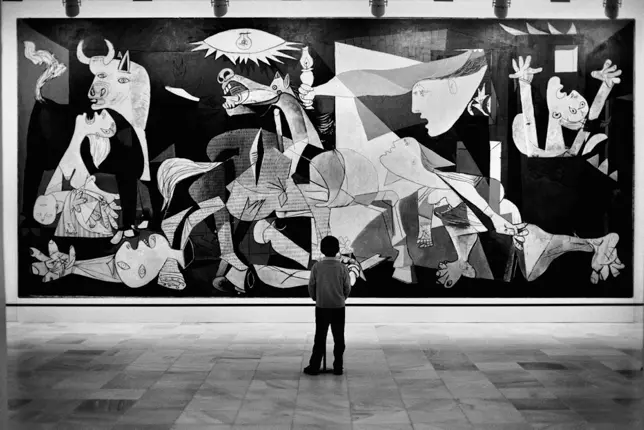
In the twentieth century, few artists disrupted artistic conventions as dramatically as Pablo Picasso. As one of the founders of Cubism, Picasso dismantled centuries of traditional perspective and representation. Instead of depicting objects from a single viewpoint, Cubism presented multiple perspectives simultaneously, fundamentally altering how reality could be visualized in painting. Picasso’s most powerful political statement is the monumental painting Guernica, created in response to the bombing of the Basque town during the Spanish Civil War. The painting’s fragmented figures, screaming animals, and chaotic composition transformed it into one of the most powerful anti-war images ever created. Through this work, Picasso demonstrated that art could function not only as aesthetic expression but also as political protest.
Another controversial and provocative figure was Salvador Dalí, one of the most recognizable representatives of Surrealism. Deeply influenced by the psychoanalytic theories of Sigmund Freud, Dalí explored the unconscious mind, dreams, and irrational imagery in his paintings. His iconic work The Persistence of Memory, with its melting clocks draped across a dreamlike landscape, challenges the stability of time and reality. Dalí’s theatrical personality, eccentric public appearances, and provocative statements also made him a polarizing figure within the art world. His danger lay in his ability to dissolve the boundaries between reality and imagination, forcing viewers to confront the strange logic of the subconscious.

Finally, one of the most unsettling painters of the modern era is Francis Bacon. Bacon’s paintings portray the human body as distorted, screaming, and violently transformed. Rather than presenting beauty or harmony, he focused on the fragility, brutality, and existential anxiety of human life. His haunting work Three Studies for Figures at the Base of a Crucifixion shocked audiences with its grotesque, monstrous forms. Bacon’s imagery reflected the trauma of the post–World War II world, capturing a sense of psychological violence and existential dread that defined much of twentieth-century thought.

In conclusion, the most “dangerous” painters in art history are those who dared to challenge the expectations of their time. Through radical realism, political critique, formal experimentation, and psychological intensity, artists such as Caravaggio, Francisco Goya, Pablo Picasso, Salvador Dalí, and Francis Bacon demonstrated that art can be more than decoration. It can question authority, expose uncomfortable truths, and transform how society understands itself. Their legacy shows that the most powerful art is often the most unsettling.


