
Fernand Khnopff's "I Lock My Door Upon Myself”
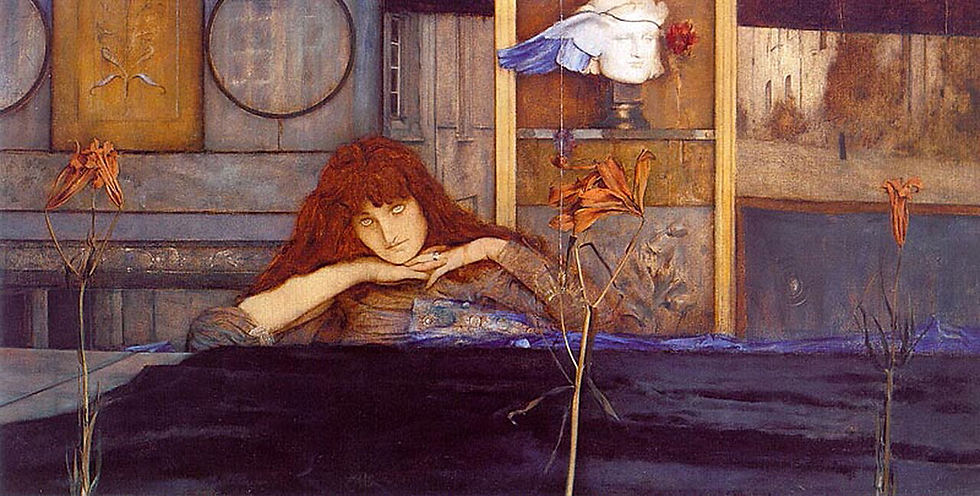
She does not look at us so much as through us. Her chin rests on her clasped hands, her copper hair spills loose, and her pale eyes are fixed on something beyond the edge of the canvas. In front of her, three orange lilies are going brown at the edges. Behind her, on a shelf, a bronze head with a single blue wing seems to doze. Nothing happens in this painting, and that is precisely the point. Fernand Khnopff called it "I Lock My Door Upon Myself", and more than 130 years later the door is still shut.
A line borrowed from London
The title comes from English poetry, not Belgian. Khnopff took it from Christina Rossetti's poem "Who Shall Deliver Me?", which opens with that same confession: "I lock my door upon myself." Rossetti's speaker shuts out the noise of the world, only to discover that the real intruder is inside. The poem asks who could ever "wall / Self from myself, most loathed of all?" Its title echoes a cry from Paul's letter to the Romans, a plea for rescue from one's own nature.
It was a natural source for Khnopff. Born in 1858 near Dendermonde and raised partly in Bruges, he was a Brussels painter who looked across the Channel more than towards Paris. He admired the Pre-Raphaelites, went on to befriend Edward Burne-Jones, and from 1895 sent regular reports on Belgian art to the London magazine The Studio. Christina was the sister of Dante Gabriel Rossetti, one of the painters Khnopff revered. Borrowing her line was a quiet act of allegiance.

But he didn't illustrate the poem. There is no prayer here, no struggle towards grace. What he painted is the moment just after the key turns: a woman alone with herself, and apparently content to stay that way.
A painting divided like an altarpiece
Step back and the canvas, which is twice as wide as it is tall, falls into three panels, almost like a medieval triptych laid on its side. The woman fills the centre and spills into the left. Horizontal bands and upright planks of wood frame her like the walls of a box. On the left, the eye meets a jumble of circles and rectangles: a disc that might be a mirror, a patch of patterned fabric, a doorway that opens onto nothing in particular.
On the right, a window gives the only view out. It is not a view of escape. We see a deserted medieval street in grey light, with a single dark figure standing in it. Viewers have long compared it to Caspar David Friedrich's lonely monk by the sea. For a painter whose childhood memories of Bruges never left him, the silent old town feels less like a place and more like a memory kept behind glass.
The palette is held to a whisper: dusty greens, greys and browns, with just a few notes of colour. Her hair, the lilies, a red poppy on the shelf and the blue of a wing. Everything else has been drained, as if the room itself were holding its breath.
The god of sleep on the shelf
That winged head is the painting's strangest guest. It represents Hypnos, the Greek god of sleep and twin brother of Thanatos, death. Khnopff almost certainly knew it from the bronze head of Hypnos in the British Museum, an ancient Roman piece the museum acquired in 1868. This canvas of 1891 is where the god first enters his work, and he never really left. Khnopff later made his own bronze version of the head and kept it in his home in a place of honour.

Here, the single wing is painted blue, the colour Khnopff tied to dreams, and it rhymes with the woman's red hair across the picture. Beside it sits a poppy, the flower of oblivion and of opium. Sleep, forgetting, a hint of death: the shelf reads like a small private altar to the state the woman seems to be drifting into.
Flowers that should be white
Lilies in Western painting usually come in white, the flower of the Virgin in countless Annunciations, of purity and promise. Khnopff's are orange, and they are dying. Their petals curl and darken, their stems bend. Placed right at the front of the picture, between us and her, they work almost like a fence. Whatever bloom this moment once had, it is passing, and she has no intention of saving it.
The table she leans on adds to the unease. It is draped in black and has the heavy, closed look of a tomb or an altar. A thin rod, read by some as an arrow or a spear, rests across it. From above, a small crown-like charm hangs on a fine silver chain, glinting in the gloom. None of these objects explains the others. Khnopff gives us clues without a crime.
Who is she?
Khnopff's favourite model was his younger sister Marguerite, whose long face and calm, distant gaze haunt much of his work, and it is tempting to see her here. Yet the woman is less a portrait than a type, the self-possessed and unreachable figure that runs through Belgian Symbolism. She is not sad in any obvious way. She is not seductive either. She simply refuses us.
Some writers have described her as hypnotised; others feel she is hypnotising the viewer. Both readings capture the same trick. Her stare is so absorbed that it pulls us in while giving nothing back, and we end up standing in front of the painting the way she sits in front of the world: watching, waiting, outside.
A painter who lived behind the door
It is hard not to read the picture as a self-portrait in disguise. Khnopff was a famously reserved man, polished and private. Around 1900 he began designing a house and studio in Brussels that friends called a "temple of the self". It was laid out in white, blue, black and gold, with a golden circle set into the studio floor and his motto inscribed above the entrance: "On n'a que soi", "one has only oneself". The house has since been demolished, but its spirit lives on in this canvas, painted almost a decade earlier. Long before he built the fortress, he had already painted the woman who would live in it.
Munich's quiet treasure
The painting did not stay in Belgium. In 1893 it was bought from the artist at the annual exhibition in Munich's Glass Palace, and it remains in the collection of the Neue Pinakothek in Munich. With that museum closed for a long renovation, the woman has, fittingly, spent recent years out of public view, still locked away.
That may be the best way to meet her. "I Lock My Door Upon Myself" is not a puzzle with an answer. It is a mood, built with great care out of circles and planks, wilting petals and a sleeping god's wing. Symbolism tried to give form to the inner life, and few paintings do it more quietly than this one. We are allowed to look into the room. We are just never invited in.


