
The Vanishing Self-Portrait: Gustav Klimt’s Most Enigmatic Missing Masterpiece
In the glittering world of early 20th century Vienna where cafés buzzed with philosophers, artists, poets, and revolutionaries few figures were as mysteriously charismatic as Gustav Klimt. Draped in his loose painting robes, rarely speaking to the press, living almost monk-like inside his studio, Klimt cultivated an aura of silence and secrecy.
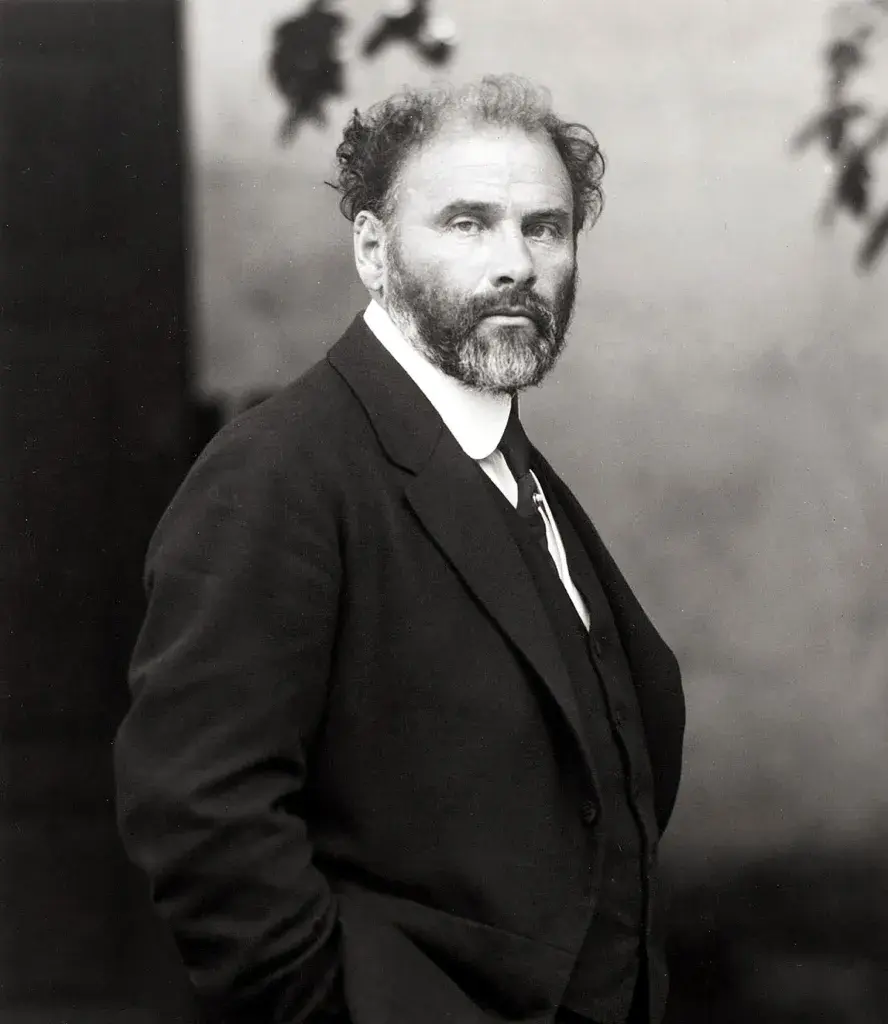
Perhaps that is why one of the most perplexing mysteries in art history centers on something Klimt almost never did: he allegedly painted a self-portrait. And then it disappeared.

A Self-Portrait That Shouldn’t Exist
Throughout his career, Klimt avoided depicting himself. “I am less interested in myself as a subject than in other people,” he once declared. His oeuvre is filled with luminous women, mythological figures, and mosaic-like golden surfaces but virtually no self-images.
Yet art catalogues from the early 20th century consistently mention a single work:
Self-Portrait (1917), attributed to Klimt himself.
For decades, it was considered the artist’s only known self-portrait. And unlike most Klimt paintings, there are no surviving photographs of it. Only descriptions. Only records. Only whispers.
The Last Public Sighting: Vienna, 1925
In 1925, the painting was reportedly exhibited at the Neue Galerie in Vienna. Critics referenced it briefly in exhibition notes, and its title appeared in the gallery’s catalogue.
Then without explanation it vanished.
Not sold. Not transferred. Not documented.
Simply gone.
The gallery kept no record of its buyer. No invoices were preserved. And after that exhibition, no collector ever claimed to own it.
War, Chaos, and Assumptions
With the rise of fascism and the devastation of World War II, countless artworks in Austria were looted, destroyed, or hidden. Naturally, scholars assumed Klimt’s self-portrait was among them.
But the assumption always felt shaky.
No Nazi looting files ever mentioned it.
No transport lists recorded it.
It never appeared in restitution claims.
It was as if the painting had evaporated.
A Letter From 2019 Changes Everything
In 2019, the grandson of an Austrian art collector discovered an old envelope among family papers. Inside was a short handwritten note dated sometime in the 1930s. It read:
“Klimt’s self-portrait is safe. I’ve sent it out of the city.”
There was no additional context. No signature. No explanation of where it went or who had it.
But it was the first real clue in nearly a century and enough to reopen the entire investigation.
Three Possible Fates
The letter sparked new theories among art historians:
1. The painting still exists in a private collection
Hidden away by a collector who either doesn’t know what it is—or knows exactly what it is and prefers silence.
2. The portrait was misattributed and never truly existed
Perhaps the catalogue entry was an error, a misunderstanding, or even a reference to an early study long lost.
3. The portrait was intentionally concealed
Vienna’s elite collectors were known to hide politically sensitive or valuable works during turbulent decades. The painting could remain in an attic, vault, or estate archive.
Why This Mystery Still Fascinates Us
Klimt’s missing self-portrait sits at the intersection of allure and absence.
Klimt rarely painted himself
If authentic, this would be his only self-image
It vanished at the height of Vienna’s cultural golden age
It might still be out there—waiting to be found
The idea that one of the most important missing artworks of the 1900s might be hanging, forgotten, in a private room somewhere is irresistible.
It is a riddle that continues to captivate museum curators, art detectives, and Klimt lovers worldwide.


