Artists Who Destroyed Their Own Work
Every studio has a dark corner. It is where the false starts go, the canvases that almost worked, the drawings that told too much. Most artists simply turn these to face the wall. A few go further and reach for the matches, the knife or the scissors.
It is tempting to read self-destruction as despair, and sometimes it is. But walk through the history of art and a more interesting pattern appears. Destroying old work has been a way to guard a reputation, to clear the ground for something new, to protest, and occasionally to make art out of the wreckage itself. Here are nine artists who turned on their own creations, arranged in roughly chronological order, and what each of them was really doing.
Michelangelo: The Bonfire of the Drawings
Michelangelo Buonarroti spent almost seventy years producing some of the most admired drawings in Western art, and near the end of his life in Rome he set many of them alight. According to Giorgio Vasari, his friend and first biographer, the old master burned a great number of his own drawings, sketches and cartoons shortly before his death in 1564.

Vasari’s explanation is striking: Michelangelo did not want anyone to see how hard he had laboured, or to imagine he was anything less than perfect. In other words, the bonfire was an act of image control. The myth of effortless genius needed the evidence of effort to disappear. What survives today, in places like the Casa Buonarroti in Florence and the Metropolitan Museum of Art in New York, gives us a glimpse of how much we lost. Those red-chalk studies for the Sistine Chapel figures are full of corrections, second thoughts and searching lines, exactly the struggle he wanted hidden.
Claude Monet: Slashing the Water Lilies
By 1908 Claude Monet was rich, famous and in his late sixties, and he was still capable of wrecking a season’s work in a single afternoon. That year, newspaper reports claimed the painter had destroyed around fifteen of his water lily canvases, a loss they valued at about $100,000. An exhibition of the series had been expected in 1907, and Monet kept delaying it; the long-awaited Water Lilies show finally opened at Durand-Ruel’s gallery in Paris in 1909.

Monet’s dissatisfaction was legendary. He scraped, repainted and sometimes simply cut through pictures that would have made another painter’s career. The pond at Giverny was changing every minute, and no single canvas could ever match it. Seen this way, his violence was not vanity but a kind of honesty: he would rather lose a painting than let a half-truth stand.
Edvard Munch: The “Horse Cure” That May Not Have Happened
Edvard Munch is often said to have punished his paintings on purpose. At Ekely, the estate outside Oslo where he lived from 1916 until his death in 1944, he worked in open-air studios and left canvases outside through rain and snow. His friend and biographer Rolf Stenersen called this treatment the “horse cure”: if a picture survived the weather, it was strong enough to live.

The story is irresistible, and the damage is real. When the city of Oslo inherited Munch’s enormous collection, many works bore water stains, flaking paint and even animal paw prints. Yet recent conservation research has made the tale more complicated. A study of dozens of paintings Munch prepared for sale in 1906 and 1907 found that much of their damage came from careless transport, handling and storage rather than deliberate weathering, and suggested Stenersen’s colourful phrase should not be taken too literally. Munch remains on this list as a reminder that legends of self-destruction can be as carefully constructed as the paintings themselves.
Lee Krasner: Murder as a Method
In 1951 Lee Krasner showed a group of new paintings at the Betty Parsons Gallery in New York. The reception was cool, and Krasner, long overshadowed by her husband Jackson Pollock, responded with something close to ferocity. She tore up drawings that had covered her studio walls and cut into the paintings from the Parsons show, turning them into raw material for collages. Looking back decades later, she described what she had done with a single blunt word: “Murder.”
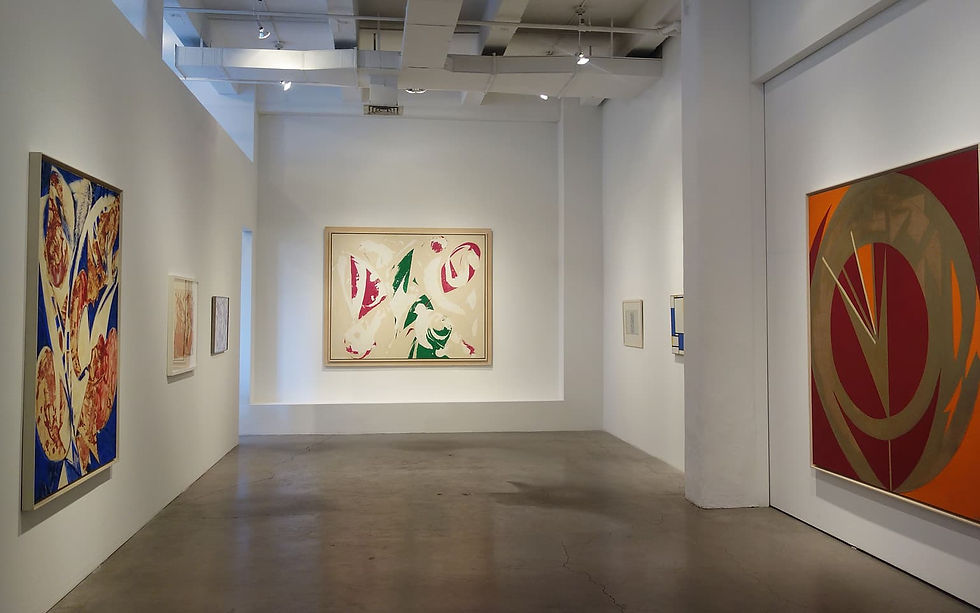
What grew from those fragments is among the strongest work of her career. The collage paintings shown at the Stable Gallery in 1955 drew high praise from the critic Clement Greenberg, while only a couple of paintings from the 1951 exhibition escaped her scissors. Krasner returned to the method in the 1970s, slicing up charcoal drawings from her student years with Hans Hofmann to build new works. For her, destruction was not the end of a picture but the beginning of the next one.
Jasper Johns: Erasing a Past at Twenty-Four
In late 1954, a young painter living in New York decided that everything he had made so far was not really his. Jasper Johns, then twenty-four, destroyed all the earlier work he still had. Very little from before that moment survives.

What came next was Flag, the encaustic-and-collage painting of the American flag that Johns began in 1954 and that would help redirect American art away from Abstract Expressionism. Johns later said the image had come to him in a dream. Whatever its origin, the purge seems to have been the necessary first step: before he could paint familiar things in an unfamiliar way, he had to stop painting like everyone else.
Agnes Martin: Clearing the Way for the Grid
Agnes Martin came to her signature style late, and she was ruthless about what came before. After arriving at her quiet, finely pencilled grids in the early 1960s, she destroyed most of her earlier paintings, leaving only a small number of the biomorphic and abstract works she had made in the 1950s.

Her rigour extended to her whole life. In 1967, at the height of her success in New York, Martin left the city for New Mexico and stopped painting altogether for several years before returning to the canvas in the 1970s. Her destruction of early work fits the same pattern of radical simplification: if a painting did not carry the stillness she was after, it had no right to exist.
John Baldessari: A Funeral for Painting
Few artists have been as theatrical about it as John Baldessari. In the summer of 1970 he gathered roughly a hundred of his own paintings, made between 1953 and 1966, and had them cremated at a mortuary in San Diego. He called it the Cremation Project.

The ashes did not simply disappear. Some were baked into cookies, and the remains were displayed in an urn alongside a bronze plaque recording the birth and death dates of the destroyed works, rather like a memorial for a departed relative. Baldessari was clearing his studio of a painting career he no longer believed in, and announcing his turn toward conceptual art, photography and text. It is hard to think of a more cheerful funeral in art history, or one that did more to launch a second life.
Joan Miró: The Burnt Canvases
At eighty, Joan Miró set fire to his own paintings, and meant every flame. In December 1973, working in Tarragona with his collaborator Josep Royo, he created a series of five Burnt Canvases. He cut and pierced the surfaces, splashed them with paint, doused them with petrol and set them alight, controlling the burn with a wet mop and a blowtorch. He walked on them, punched holes through them and nailed the scorched remains back onto their charred stretchers.

These were not failures being disposed of but new works born from destruction. Miró described his aim as an “assassination of painting”, a rejection of art as an elite luxury and a protest against the violence of Franco’s Spain. Shown in 1974 at his retrospective at the Grand Palais in Paris, some were hung so that visitors could see both front and back, holes and all. A painter who had spent a lifetime building pictures used his final decade to show how fragile, and how political, a picture can be.
Francis Bacon: The Studio of Slashed Canvases
Francis Bacon was notorious for destroying canvases that displeased him, and the evidence was waiting in his studio. After his death in 1992, the cramped room at 7 Reece Mews in London was dismantled and moved, object by object, to the Hugh Lane Gallery in Dublin, the city of his birth. The material arrived in 1998, and archivists catalogued around 7,000 items.

Among the paint-crusted brushes, photographs and torn pages were about a hundred slashed and destroyed canvases. They show an artist who was his own harshest critic, cutting out the parts that failed and abandoning the rest. Today they offer something Bacon never intended to share: an unfiltered look at the paintings that did not make it, which turn out to say a great deal about the ones that did.
Why We Can’t Look Away
Each of these stories touches the same nerve. We tend to think of an artwork as a finished, precious object, but to the person who made it, it is often just one stage in a long argument with themselves. Sometimes the argument ends in fire.
What remains, oddly, is often more revealing than what was destroyed. Michelangelo’s surviving sketches, Krasner’s collages, Baldessari’s urn and Bacon’s slashed canvases all show us the moment when an artist decided who they were not, and that is often the clearest way of seeing who they were.